Recovery after stroke, neurological injury, or prolonged illness often requires repetitive, guided movement.
The brain must relearn patterns. Muscles must rebuild strength. Balance must be retrained.
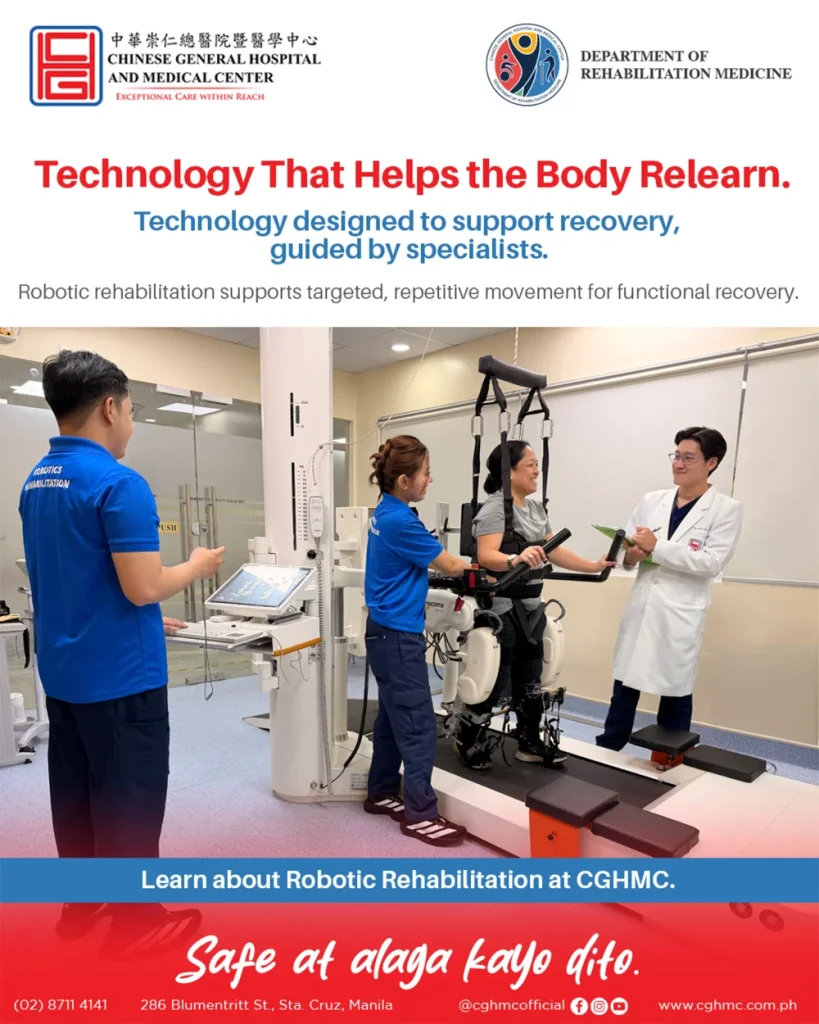
Robotic rehabilitation is designed to support this process.
It is not a replacement for physical therapists. It is a structured tool that helps patients practice movement safely, consistently, and with measurable precision.
At Chinese General Hospital and Medical Center (CGHMC), robotic rehabilitation is part of an integrated recovery program within Rehabilitation Medicine.
What Is Robotic Rehabilitation?
Robotic rehabilitation uses advanced equipment that guides specific body movements during physical therapy sessions.
These devices assist patients in:
- Walking
- Improving gait patterns
- Strengthening limbs
- Re-learning coordinated motion
The technology supports controlled, repetitive movements — which are essential for neurological recovery.
Repetition helps the brain rebuild connections. Structured repetition accelerates progress.
Why Repetition Matters in Recovery
After stroke or neurological injury, the brain’s communication with muscles may be disrupted.
Recovery depends on neuroplasticity — the brain’s ability to reorganize and form new pathways.
Consistent, guided movement encourages this process.
Traditional therapy provides repetition, but robotic therapy recovery enhances it by:
- Maintaining consistent movement patterns
- Reducing fatigue-related variability
- Allowing longer practice duration
- Providing real-time feedback
This structured repetition improves motor relearning.
Who Benefits from Robotic Rehabilitation?
Robotic rehabilitation in the Philippines is commonly used for:
Stroke Patients
Stroke robotic therapy supports:
- Gait retraining
- Lower limb strength
- Balance recovery
- Symmetry correction
Early rehabilitation can significantly improve long-term mobility.
Spinal Cord Injury
Patients recovering from spinal cord injury may use robotic support to:
- Assist partial weight-bearing
- Encourage correct walking mechanics
- Improve endurance safely
Other Neurological Conditions
Conditions such as:
- Parkinson’s disease
- Multiple sclerosis
- Brain injury
may benefit from guided movement therapy to maintain function.
Post-Surgical Weakness
Some patients recovering from prolonged hospitalization experience muscle deconditioning. Robotic-assisted movement can reintroduce safe activity gradually.
How Does Robotic Rehabilitation Work?
During a typical session:
- The physiatrist evaluates the patient’s current ability and eligibility for therapy.
- The therapist assesses functional level and adjustments needed.
- The robotic device is adjusted to match the patient’s strength and range.
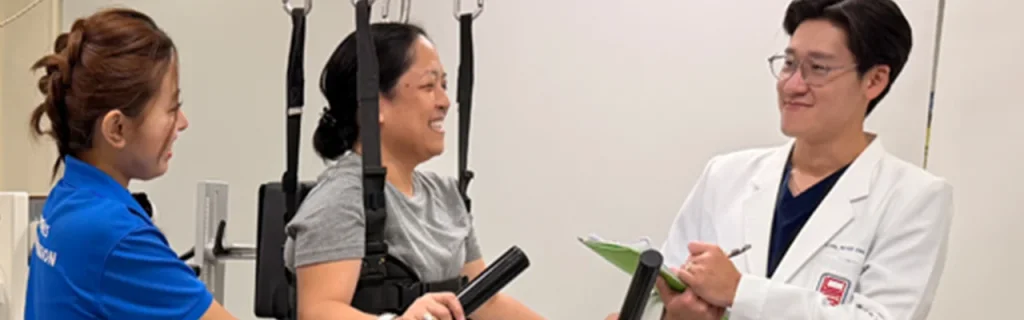
- The equipment guides movement while the therapist supervises closely.
- Settings are modified as the patient improves.
The device may support:
- Body weight during walking
- Controlled limb movement
- Adjustable resistance levels
Each session is individualized.
The therapist remains actively involved at every stage.
It Supports — It Does Not Replace
One common misconception is that robotic rehabilitation replaces therapists.
This is not accurate.
Rehabilitation physicians and therapists:
- Design the therapy plan
- Adjust device parameters
- Monitor progress
- Ensure safety
- Provide encouragement and correction
Technology enhances therapy. It does not eliminate human expertise.
Recovery remains guided by trained professionals.
Safety and Supervision
Safety is central to robotic rehabilitation.
At CGHMC:
- Patients are assessed before starting robotic therapy
- Vital signs are monitored
- Devices are calibrated carefully
- Therapists supervise continuously
Robotic therapy is only recommended when appropriate for the patient’s condition.
Not all patients require robotic support. It is introduced when it can provide measurable benefit.
Benefits of Robotic Therapy Recovery
Patients may experience:
- Improved walking pattern
- Increased endurance
- Greater muscle activation
- Better balance
- Faster functional gains
Because movement is guided precisely, patients often feel more stable and confident during therapy sessions.
This confidence encourages participation and motivation.
When Is Robotic Rehabilitation Recommended?
Doctors may recommend robotic rehabilitation if:
- Progress with traditional therapy has plateaued
- Walking is severely impaired
- Consistent gait pattern retraining is required
- Intensive repetition is needed
Each recommendation is personalized.
Rehabilitation is not one-size-fits-all.
Integration with Full Rehabilitation Care
Robotic rehabilitation is not a standalone treatment.
It works alongside:
- Physical therapy
- Occupational therapy
- Speech therapy (when needed)
- Medical monitoring
This integrated approach ensures recovery remains balanced and comprehensive.
Technology becomes one part of a broader care strategy.
Emotional Impact of Structured Recovery
For many patients, the ability to stand or walk again — even with assistance — provides emotional reassurance.
Structured robotic sessions can:
- Improve morale
- Increase engagement
- Restore hope
- Reinforce measurable progress
Recovery is not only physical. It is also psychological.
Why Choose CGHMC for Robotic Rehabilitation in the Philippines?
CGHMC offers:
- Advanced rehab robotic technology
- Experienced rehabilitation physicians
- Skilled physical therapists
- Integrated hospital-based care
- Structured recovery programs
Because CGHMC is a full-service medical center, patients benefit from coordinated monitoring across specialties.
Rehabilitation is connected to cardiology, neurology, oncology, and surgical teams when needed.
Technology That Helps the Body Relearn
Robotic rehabilitation does not promise instant results. It provides structured support. It offers guided repetition. It enhances consistency. And when used appropriately, it helps the body relearn movement safely.
Learn More
If you or a loved one is recovering from stroke or neurological injury:
Learn how robotic rehabilitation supports recovery at CGHMC.
Call (02) 8711 4141 to inquire about Rehabilitation Medicine services.
Safe at Alaga Kayo Dito.