
“Rayuma lang ’yan.”
It’s something many Filipinos have heard.
Your knees start aching when you walk.
Your fingers feel stiff when you wake up.
An ankle suddenly becomes swollen.
Your shoulder doesn’t move as easily as it used to.
And because joint pain is so common—especially as we get older—it can be easy to put everything under one familiar word:
Rayuma.
But medically, “rayuma” doesn’t tell us exactly what is happening.
Persistent joint pain, stiffness, swelling, or difficulty moving can have many different causes. It could be related to an injury.
It could be osteoarthritis.
It could be an inflammatory condition such as rheumatoid arthritis.
It could be gout.
And sometimes, the source of pain may not even be the joint itself.
That distinction matters because these conditions are not treated in exactly the same way. So instead of simply asking:
“May rayuma ba ako?” A more useful question is:
“What is actually causing my joint symptoms?”
First: What Exactly Is “Rayuma”?
In everyday Filipino conversation, rayuma is often used broadly to describe aching joints, arthritis, or recurring musculoskeletal pain.
Someone might say they have rayuma because their knees hurt when it rains, their hands feel stiff in the morning, or their joints have become painful with age.
But “rayuma” by itself is not a precise diagnosis.
The medical term arthritis, meanwhile, refers to conditions involving inflammation or structural changes affecting one or more joints.
And even arthritis isn’t one disease.
There are many different forms.
Two people can both say:
“Masakit ang tuhod ko.”
Yet one may have osteoarthritis while the other has an injury, gout, inflammatory arthritis, or another musculoskeletal problem.
Same symptom.
Different cause.
Potentially different treatment.
That is why getting the diagnosis right matters.
Four Joint Changes Worth Paying Attention To
An occasional ache after a long day doesn’t necessarily indicate a serious joint problem. Here are four changes that deserve attention when they are persistent or interfere with everyday life.
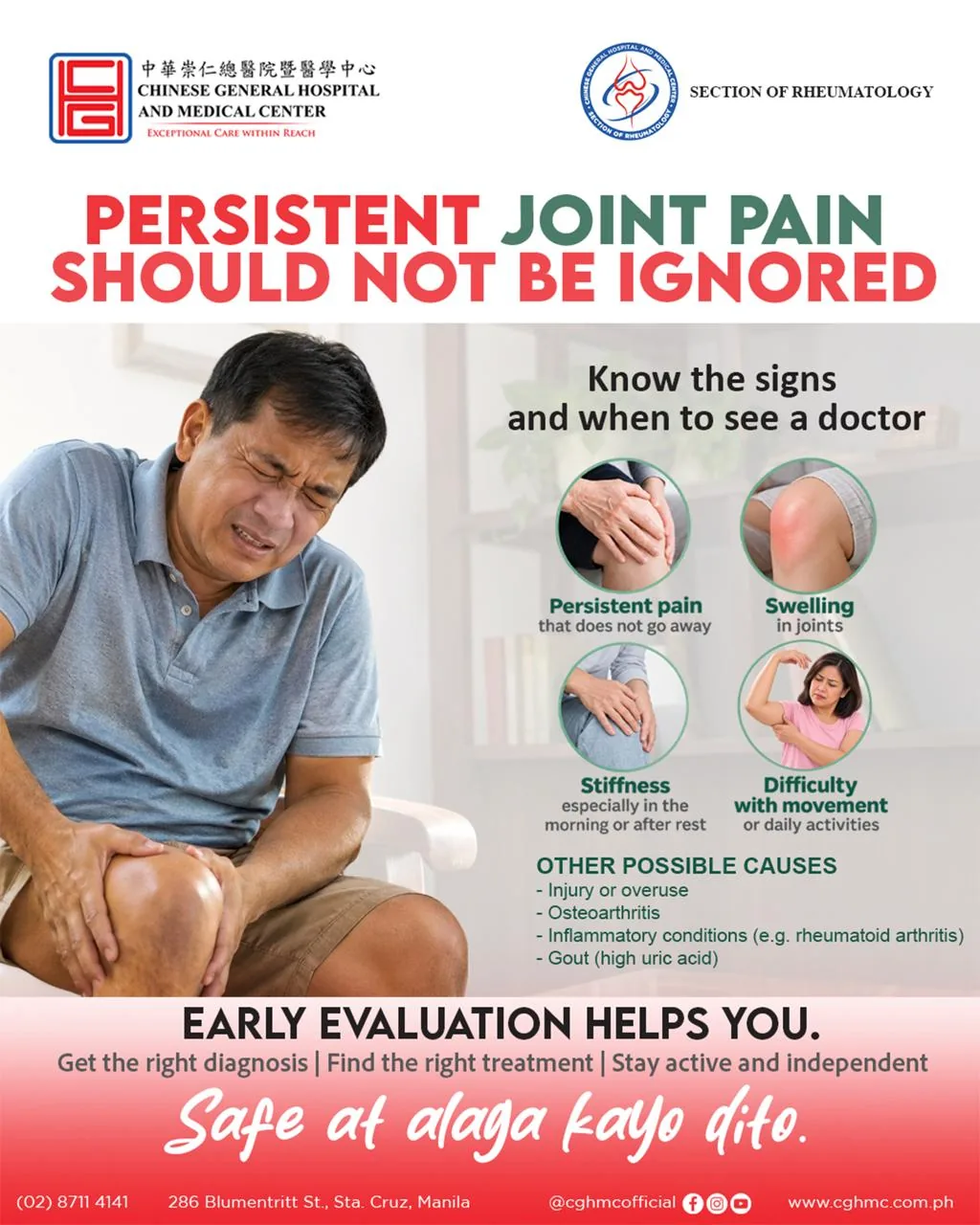
1. Pain That Doesn’t Go Away
Joint pain can occur after exercise, repetitive activity, minor injury, or simply doing more than your body is accustomed to.
Often, it improves.
But pain that continues, repeatedly returns, becomes more severe, or begins limiting normal activities deserves closer attention.
Where the pain occurs also matters.
Is it one knee?
Several joints?
Both hands?
Does movement make it worse?
Does it hurt even while resting?
Did it start suddenly or gradually?
Those details help doctors narrow down what might be happening.
Pain is a symptom.
Its pattern can provide clues to its cause.
2. Swelling Around a Joint
A swollen joint can sometimes be easier to notice than pain.
The area may appear visibly enlarged, feel tight, warm, or tender, or become difficult to move. Swelling can occur after an injury, but it may also accompany arthritis, gout, infection, and other conditions.
And the timing can matter.
A knee that gradually becomes swollen over months tells a different story from a joint that suddenly becomes very painful, red, hot, and swollen overnight. That second pattern can require more urgent evaluation.
When a joint gets really inflamed, it’s not just about stopping the pain; it’s also about figuring out what’s causing it.
3. Stiffness—Especially in the Morning or After Rest
You wake up.
You put your feet on the floor.
Your knees, hips, or hands don’t immediately cooperate.
They feel stiff.
After moving around for a while, they loosen up.
Joint stiffness after rest can occur with several musculoskeletal conditions.
But physicians often ask an important follow-up:
How long does the stiffness last?
A brief period of stiffness can occur in degenerative joint conditions such as osteoarthritis. Longer-lasting morning stiffness, particularly when multiple joints are involved, can raise the possibility of an inflammatory condition such as rheumatoid arthritis.
This doesn’t mean you should diagnose yourself based on the clock.
It means the pattern of stiffness is useful medical information.
When you see your doctor, tell them whether stiffness lasts five minutes, thirty minutes, an hour, or longer.
Those details matter.
4. Difficulty Moving or Doing Everyday Activities
Joint problems don’t always announce themselves through severe pain.
Sometimes, you notice what you can no longer do comfortably.
Going upstairs becomes difficult.
You avoid squatting.
Opening a jar hurts.
Standing from a chair takes more effort.
You can’t raise your arm as high as before.
Walking the same distance becomes harder.
When pain or stiffness begins affecting daily activities, it is no longer simply an inconvenience. It is affecting function.
And preserving function is one of the major goals of orthopedic and rehabilitation care.
The objective isn’t simply to make a painful joint hurt less.
It’s to help you move, work, exercise, and remain as independent as possible.
What Could Be Causing the Pain?
This is where “rayuma” becomes too broad.
Several conditions can produce overlapping symptoms.
Injury or Overuse
Sometimes the explanation is relatively straightforward.
A sudden twist, fall, sports injury, repetitive movement, or increased physical activity can affect muscles, tendons, ligaments, cartilage, bones, or joints.
But even an apparent injury shouldn’t always be ignored. Persistent pain after an injury may indicate damage that requires evaluation, particularly if there is significant swelling, instability, weakness, or inability to use the affected limb normally. Overuse can also produce symptoms gradually.
You may not remember one dramatic moment when something went wrong.
Instead, the pain simply becomes more noticeable over time.
Osteoarthritis: When the Joint Changes Over Time
Osteoarthritis is one of the most common forms of arthritis.
It involves changes in the tissues within a joint, including cartilage and underlying bone, and becomes more common with age.
It frequently affects areas such as the:
- knees
- hips
- hands
- spine
Symptoms can include pain during or after movement, stiffness after inactivity, reduced range of motion, and sometimes swelling.
People often describe osteoarthritis as simple “wear and tear,” but the biology is more complicated than something merely wearing out.
The entire joint can be affected.
And although osteoarthritis cannot simply be reversed, appropriate management can help reduce symptoms and preserve function.
Depending on the individual, this can involve exercise, weight management where appropriate, physical therapy, medications, injections, assistive strategies, and—in more advanced cases—surgical options.
Rheumatoid Arthritis: When the Immune System Attacks the Joints
Rheumatoid arthritis is very different from osteoarthritis.
It is an autoimmune inflammatory disease.
Instead of primarily developing from degenerative changes within a joint, rheumatoid arthritis occurs when the immune system mistakenly attacks tissues in the body, including the lining of the joints.
It often affects multiple joints and can commonly involve the hands, wrists, and feet. Symptoms may include:
- joint pain
- swelling
- warmth
- prolonged morning stiffness
- fatigue
- reduced joint function
Because rheumatoid arthritis is an inflammatory systemic disease, early recognition and appropriate medical treatment are important.
This is a good example of why simply calling both conditions “rayuma” can be misleading. While osteoarthritis and rheumatoid arthritis can both make joints hurt, they are not the same disease and do not require the same treatment strategy.
Gout: When Uric Acid Crystals Trigger Inflammation
Then there is gout.
Gout is a form of inflammatory arthritis associated with the formation of urate crystals in and around joints when uric acid levels in the body contribute to crystal formation.
A gout attack can appear dramatically.
A joint may suddenly become extremely painful, swollen, red, warm, or very sensitive to touch.
The big toe is famously associated with gout, but gout can affect other joints, including the ankles and knees.
And while diet can influence gout risk and attacks, it is an oversimplification to describe gout as simply the result of “eating too much.”
Kidney function, genetics, medications, other health conditions, body weight, alcohol intake, and other factors can also play roles.
Proper evaluation helps determine whether gout is actually responsible for the symptoms and what management is appropriate.
Why Getting the Right Diagnosis Matters
Imagine treating every cough the same way.
We wouldn’t.
A cough from an infection isn’t necessarily managed the same way as one caused by asthma, reflux, or another condition.
Joint pain deserves the same thinking.
Painkillers may temporarily make a joint feel better.
But reducing pain does not necessarily identify or address its underlying cause.
A proper evaluation may include a medical history and physical examination. Depending on the suspected condition, doctors may also recommend tests such as X-rays, ultrasound, MRI, blood tests, or examination of fluid taken from a swollen joint. Not every patient needs every test.
The appropriate investigation depends on what the doctor is trying to determine. The objective of diagnosis is to select the appropriate diagnostic test that will provide the necessary information to address the specific medical inquiry.
When Should You See a Doctor?
You don’t need to see a specialist for every minor ache after exercise.
But evaluation becomes more important when joint symptoms:
- persist or repeatedly return
- are getting worse
- cause significant swelling
- produce prolonged stiffness
- reduce your range of motion
- interfere with walking or everyday activities
- affect several joints
- occur without an obvious explanation
And some situations deserve prompt medical attention.
A joint that suddenly becomes extremely painful, hot, red, and swollen—especially when accompanied by fever or feeling unwell—should not simply be assumed to be gout or “rayuma.” Joint infection and other urgent conditions may produce similar symptoms and need timely medical evaluation.
Likewise, seek urgent care after a significant injury if the joint appears deformed, you cannot bear weight or use the limb, or there is severe pain or swelling.
Don’t Let “Rayuma” Become the End of the Conversation
There is nothing wrong with using the word rayuma.
It’s familiar.
It’s part of how many Filipino families talk about joint pain.
The problem comes when the label becomes a reason not to investigate persistent symptoms.
“Rayuma lang.”
“Matanda na kasi.”
“Lilipas din.”
Sometimes it does pass. Sometimes it doesn’t.
And sometimes what feels like ordinary joint pain is a condition that can be managed more effectively when it is identified earlier.
At CGHMC, patients can receive comprehensive care for bone, joint, and musculoskeletal concerns, supported by specialist evaluation, diagnostic services, rehabilitation, and individualized treatment based on their condition.
The goal isn’t simply a diagnosis. It’s to understand why you’re hurting, what can be done about it, and how we can help you keep moving.
So, if the pain keeps coming back, the swelling doesn’t disappear, or stiffness is beginning to change how you live:
Don’t settle for “Rayuma lang ’yan.”
Find out what it really is.
Know Earlier. Act Earlier. Move Better.