University of Santo Tomas and Chinese General Hospital and Medical Center Consortium Urology Residency Program
Strong Foundations in Urology. Training for the Future of Urologic Care.
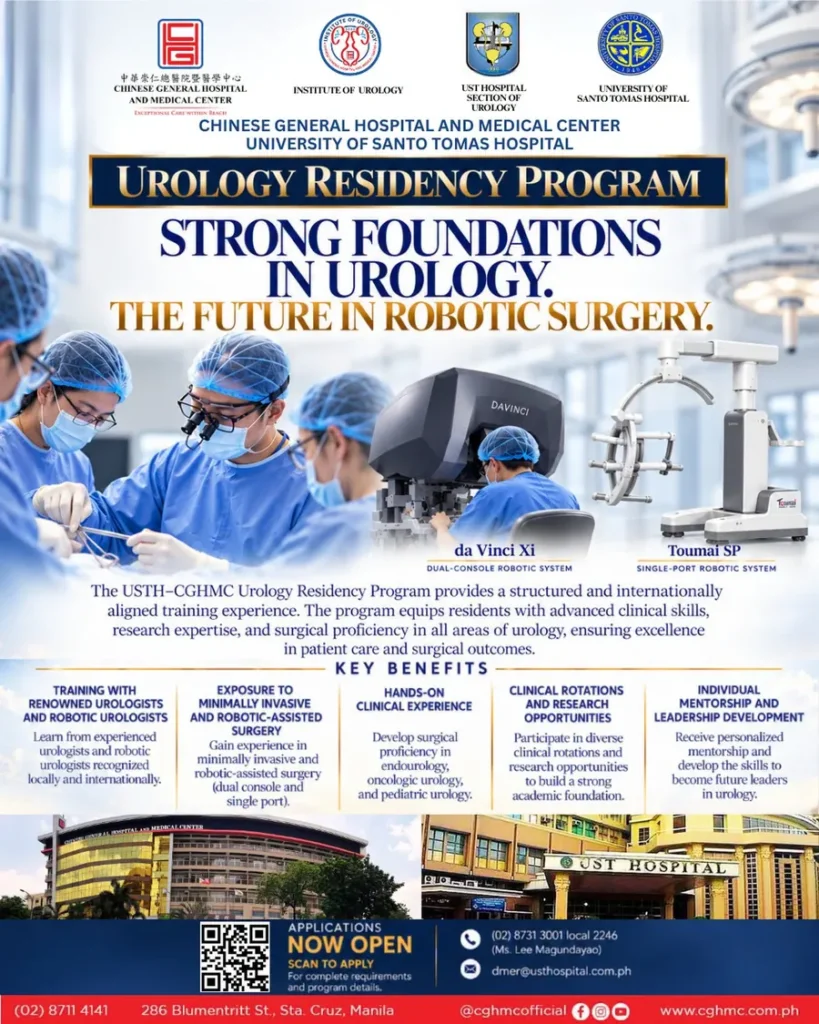
The University of Santo Tomas Hospital–Chinese General Hospital and Medical Center (USTH–CGHMC) Consortium Urology Residency Program brings together two major teaching institutions to provide physicians with comprehensive training across the full spectrum of urology.
The collaboration between USTH and CGHMC began in 2017 to further strengthen resident training, combining the clinical experience, faculty expertise, patient populations, facilities, and technologies of both institutions. The affiliation subsequently received accreditation from the Philippine Board of Urology (PBU).
The program is designed to develop well-rounded urologists with strong foundations in clinical decision-making, patient care, research, and surgical practice—while progressively exposing residents to minimally invasive and advanced robotic techniques.
Comprehensive Urology Training Across Two Institutions
Residents train within both University of Santo Tomas Hospital and Chinese General Hospital and Medical Center, allowing them to encounter a broad range of urologic conditions, surgical procedures, subspecialties, and clinical settings.
Training encompasses:
- General Urology
- Urologic Oncology
- Pediatric Urology
- Infertility and Sexual Dysfunction
- Endourology
- Urodynamics and Female Urology
- Reconstructive Urology
- Advanced Laparoscopic Surgery
- Robotic-Assisted Surgery
- Clinical Research
The Philippine Urological Association notes that the USTH–CGHMC collaboration expanded residents’ exposure particularly in urologic oncology, advanced endourology, MRI-fusion prostate biopsy, and robot-assisted laparoscopic surgery. Philippine Urological Association (PUA)
Strong Foundations. Progressive Surgical Training.
The objective is not simply to expose residents to advanced technology. The program develops proficiency progressively—from the fundamentals of urology and conventional surgical techniques to endoscopic, minimally invasive, laparoscopic and robotic approaches.
Residents learn from experienced urologists and subspecialists while developing increasing clinical and operative responsibility throughout their training.
The training experience combines clinical rotations, operative experience, academic conferences, research opportunities, individual mentorship, and leadership development.
Robotic Surgery Integrated Into Urology Training
As urologic surgery continues to evolve, exposure to robotic-assisted surgery forms part of the program’s advanced surgical training.
CGHMC provides access to two robotic surgical platforms: the da Vinci Xi® dual-console robotic surgical system and the Toumai® single-port robotic surgical system. This complements residents’ training in open, endoscopic and laparoscopic techniques rather than replacing these fundamental surgical competencies.
The dual-console environment is particularly relevant to surgical education because it allows structured interaction between an experienced robotic surgeon and the trainee during appropriate cases.
The consortium’s emphasis on advanced urologic technologies builds on an established training partnership. The Philippine Urological Association documents that residents have received additional exposure to robotics and other advanced procedures through the consortium and its external rotations.
What Residents Can Expect
Training with renowned urologists and robotic urologists
Learn under experienced faculty representing multiple urologic subspecialties and areas of surgical expertise.
Exposure to minimally invasive and robotic-assisted surgery
Develop familiarity with advanced laparoscopic and robotic approaches, including exposure to dual-console and single-port robotic platforms.
Hands-on experience across urologic subspecialties
Build clinical and surgical proficiency in endourology, urologic oncology, pediatric urology, reconstructive urology and other core areas of the specialty.
Clinical rotations and research opportunities
Train across two teaching institutions while participating in academic activities and clinical research designed to strengthen evidence-based practice.
Individual mentorship and leadership development
Receive guidance from faculty while developing the clinical judgment, professionalism, communication and leadership capabilities required of the next generation of urologists.
Residency Program Structure
The Urology Residency is a six-year comprehensive training program with two entry pathways:
URO 1 – Straight Program
For physicians entering urology residency from the first year of training.
URO 3 – Lateral Entry
For qualified applicants who have already completed two years of General Surgery training, subject to the program’s current admission and accreditation requirements.
Applicants should confirm the availability and specific requirements of each entry pathway with the USTH Department of Medical Education and Research for the current recruitment cycle.
Application Requirements
Applicants should prepare the following:
✓ Class Ranking
✓ Transcript of Records
✓ Certificate of Internship
✓ PRC Board Rating
✓ PRC License
✓ Letter of Intent
✓ Recommendation Letters
Letter of Intent
The Letter of Intent should be addressed to:
Maria Piedad R. Natividad, MD
Chair, Department of Medical Education and Research
University of Santo Tomas Hospital
Recommendation letters are preferably from the applicant’s Dean, Clerkship/Internship Coordinator, or Department Chair.
Beyond Residency: Urologic Oncology Fellowship
For urologists seeking further subspecialty training, the USTH–CGHMC collaboration also includes a Urologic Oncology Fellowship, established in 2022. The Philippine Urological Association describes the fellowship as designed to advance urologic oncology diagnosis and management using contemporary technologies.
CGHMC’s training information describes the fellowship as providing additional exposure to clinical cases, procedures, technologies and multidisciplinary learning through affiliated institutional training. CGHMC
This creates a training continuum from comprehensive residency education to focused subspecialty development in urologic oncology.
Build Your Future in Urology
The USTH–CGHMC Consortium Urology Training Program combines the academic tradition of USTH with the clinical breadth, subspecialty expertise and advanced surgical capabilities available across both institutions.
The goal is clear: to develop urologists with strong foundations in the full discipline of urology, while preparing them for the technologies and surgical approaches shaping its future.
Applications and Inquiries
Dr. Jio Jerome A. Co
Mobile: 0943 616 0292
Ms. Lee Magundayao
Department of Medical Education and Research
University of Santo Tomas Hospital
Telephone: (02) 8731 3001 local 2246
Email: [email protected]